Slackers love sausage sandwiches but are often disappointed by under//overcooked outcomes. This recipe guarantees satisfaction – at the very least. Suitably modified both vegans and veggies can enjoy this recipe.
Ingredients
Two Cumberland sausages1 (any sausage will do but it should be chunky)
Two thick slices of Hovis bread
Onion
Technique
Dice onion and sauté in pan with knob of butter (unreconstructed Slackers will use the frying pan)
Fry sausage gently for a few minutes till it’s golden brown
Take sausage out and cut in half. Smear mustard on exposed inner sides
Back in the frying pan face down. Cook for a couple of minutes
Lay sausage halves evenly spaced on a slice of bread. Cover with onion to taste. (don’t butter the bread the onion is more than enough). Other slice on top and halve
Outcome
A perfect sandwich
Finally
You’ll regret the dozens of inferior sausage sandwiches you’ve eaten but get over it and wash up.
After the war. Karl Höcker1 was arrested and spent eighteen months in a prisoner of war camp before being released. He returned to his old job with the same bank he’d been employed by before the war. In 1952 he turned himself in for denazification and was sentenced to nine months in prison for membership of the SS, but, because of a 1954 amnesty law, didn’t serve a single day. In the 1960s, however, Höcker was sentenced to seven years for aiding and abetting the murder of one thousand people. On his release he was, yet again, given his old job back, at the same bank, working there until his retirement.
Note
1 Karl Höcker was a senior SS officer in Auschwitz from May 1944 to the end of the war.
Ryan, William ; The Constant Soldier: p454, pp456-7 Crazy Horse Publishing. Kindle Edition.
This quirky book instantly attracted me. The story is straight-forwardly about property in Poland. Jewish Holocaust survivors made it to the USA. Two generations later a grandson tried to prove ownership rights over a house plundered by Nazis. Kaiser’s book puts his attempts at restitution into an interesting personal context.
His search was focused on an address Malachowskiego 12 in Sosnowiec.1 Seventy years after the war the street had been renumbered and Number 12 had ‘moved’. His sleazy conspiratorial activities at number 12 were literally misplaced “It was, in fact, the wrong building.”2
The actual property, 34 Malachowskiego, wasn’t ‘ancestral’. It was an investment property. This weakened his emotional commitment to stolen family property. Nonetheless he wished to assert ‘property rights’, especially if they were valuable.
Kaiser discovered a sub-industry of Polish and Jewish Nazi treasure hunters. Many were delusional. The search for a Nazi ‘gold train’ featured heavily. Unbelievably, a distant relative and Camp Survivor, had written a book, which was the holy grail for treasure hunters. This connexion made Kaiser a celebrity opening new opportunities. He toured the sites of his ancestors’ camps, most of which had become open fields. This, chillingly, included a shopping mall.
Try this
“…this is an astonishing origin story. Abraham risks his life by jotting journal entries on stolen scraps of cement packaging. Whenever he’s set to be transferred to another camp, he hides his ‘diary’ beneath the latrine. Against all the odds he survives, and in the weeks after liberation, he borrows a bicycle from the woman who’d hidden him and he rides from camp to camp, collecting his notes.”3
Notes
1 p8
2 p165
3 pp207-8 The book is constantly reprinted in Poland and is Za Drutami Smierci (There isn’t an English translation so far as I can see)
“It is said that God is always on the side of the big battalions.” Voltaire
The fast-striking motorized element of the German army in 1941 consisted of only 35 divisions out of 130. Three-quarters of the German army continued to rely on more traditional traction: foot and horse. The German army in 1941 invaded the Soviet Union with somewhere between 600,000 and 750,000 horses…The vast majority of Germany’s soldiers marched into Russia, as they had into France, on foot.1 (my emphasis)
The Wehrmacht’s three European campaigns between 1939 and 1941 in Poland, western Europe and the USSR escalated in complexity and ambition. The first two were triumphs with rapid victories. This led Hitler to believe the Wehrmacht was ‘invincible’. His brilliant propaganda chief, Joseph Goebbels, stoked that belief with gusto. Dramatic Blitzkrieg footage fed a narrative arc of motorised army units sweeping enemy forces to one side.
Analysing the basics of the three military campaigns reveals the chasm between 1939, 1940 and 1941. There was a no military equivalence, though Hitler believed there was. His conceptual misunderstanding should have been corrected by his generals but they were too spineless to disagree with him.
The partition of Poland, 1939
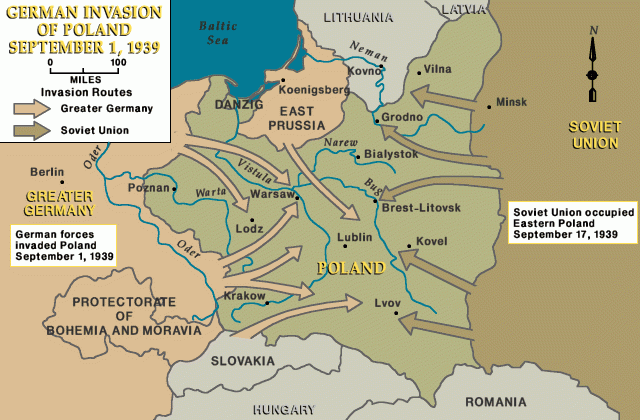
This campaign was the least ambitious of the three campaigns. In a brilliant diplomatic coup Hitler engineered a treaty with the USSR.2 The treaty secretly partitioned Poland after coordinated attacks from east and west. Hitler,”…demanded that Poland be conquered in six weeks, but German planners thought that it would require three months.3 That Hitler was correct and his advisors wrong became significant. Advisors who differed from Hitler were side-lined in the future.
Hitler’s triumphs made him difficult to advise. General Manstein said,
Whenever [Hitler] perceived he was not making any impression with his opinions on operational matters, he immediately produced arguments from the political or economic sphere. Since he had knowledge of the political situation or economic circumstances which a front-line commander did not possess, his arguments on such matters were generally irrefutable.4
The Basics German army:5 1.5 million; USSR army: 0.5 million; Polish army: 0.75 million (active); Therefore, the Polish army was massively outnumbered and they were fighting on two-fronts.
German target territory: 75,000 sq.miles (48% of Poland’s territory in1939)
Outcome: The partition of Poland by Germany and USSR
Comment: Polish defenders kept the invading armies at bay for 35 days, which was only seven fewer than the Allies managed in 1940. Their air force dramatically escaped to western Europe. Those who joined the RAF became the most successful pilots in the battle of Britain.6
1940: An Unrepeatable Triumph
The German triumph was the best prepared in military history. Preparation ‘began’ in the 1860s, which led to the 1870 triumph. Further invasion plans were written in the 1890s and early 1900s ending with the Schlieffen Plan, 1906. Crass modifications ruined the Plan in 1914-8. The attack petered out in trench warfare instead of being a war of mobility. In 1940 Germany’s Panzer units implemented Schlieffen’s plan. They routed the Allies in six weeks.
The logistics were impeccable. France was mapped in minute detail. Their excellent road network and compatible railway gauge facilitated the invasion. The conquest was a technocrat’s dream. Every variable was a reviewed and critically appraised known known prior to the invasion.
Because the invasion of France had been planned one way or another for 70 years, Hitler’s views were tinkering.
The Basics
German army: 136 divisions (about two million men); France, Britain, Belgium and Holland: 145 divisions
German target territory: 258,283 sq.miles (France, Belgium, Holland and Denmark)
Outcome: The Allies lost in six weeks
Comment: On every single metric Germany’s 1940 campaign was a stunning success. The sheer incompetence of the French is breath-taking because they too had 70 years to review and analyse the predicted invasion. They poured resources into a 1930s version of trenches: the Maginot Line. Static defence is the ultimate counsel of despair. Germany just about doubled with these conquests.
1941: Operation Barbarossa
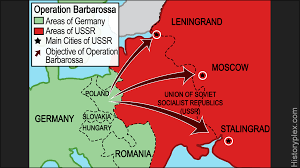
Operation Barbarossa was more ambitious than Napoleon’s 1812 invasion. Hitler had three principal objectives, which sub-divided the Wehrmacht. Hitler’s targets were Leningrad, Moscow and Stalingrad. Assuming a straight north-south frontline, that’s a distance of 962 miles. It’s impossible to defend this without overwhelming manpower, which the Germans didn’t have.
Those 962 miles illustrate the challenges for the Wehrmacht. Assuming they began the invasion in Warsaw, the Germans were committed to huge distances. The minimum distance between Warsaw and Leningrad is 633 miles; Warsaw – Moscow 713 miles and Warsaw – Stalingrad 1049 miles. This gigantic arc radiated from Warsaw. As Tooze said (see header), “The vast majority of Germany’s soldiers marched into Russia…on foot.” Goebbels propaganda showed the Wehrmacht as motorised; the actuality was very different. They had to control an area bigger than western Europe, but the USSR created a uniquely hostile environment with their Scorched Earth policy.7 This is in complete contrast to the French who collaborated with Hitler with a pro-Nazi government at Vichy.
Hitler’s military experts should have pointed out that the conquest of western Europe wasn’t equivalent to an invasion of the Soviet Union. They didn’t because it was a core objective of Hitler dating back to Mein Kampf, 1925. Their reticence was probably fuelled by vivid memories of TheNight of the Long Knives, 1934. Hitler’s political enemies were murdered in that event.8 It’s dangerous critiquing a murderer.
The Basics
German army 1941: Germany 5 million; USSR 2.94 million
Germany (including Austria and Czechoslovakia): 255,283 sq. miles; European USSR: 1,855,821 sq. miles. (This is seven times larger than Germany.)
Outcome: German defeat in 1945, or just under four years (Hitler’s estimate, of victory, was five months)
Comment: The Germans reduced their military capacity by garrisoning western Europe. Worse, their army was further reduced by their grim internal strategies. These included a repressive police state and concentration camps, both of which saw manpower seeping away unproductively. Germany had a superior army to the USSR in 1941 but the USSR had triple the manpower. In 1945 their Soviet Union’s army stood at 13.2 million, whilst the Wehrmacht had shrunk.
Conclusion
This simplistic analysis is useful but it doesn’t feed the narrative that the Wehrmacht’s ultimate fate was sealed once Operation Barbarossa began. There were many things which could have happened. The Ukraine could have been utilised, building on the outcomes of the 1930s Great Terror,
On the one hand, the massacres reinforced hatred against Soviet rule and enhanced Ukrainian enthusiasm for Germany. Since the opening of the prisons coincided with Germany’s invasion of the Soviet Union, it was easy to associate Germany with liberation and the Soviet Union with oppression.9 (my emphasis)
But ‘What if’ history is a form of novel writing. Nazi Germany operated on ideological tramlines and certain decisions couldn’t be contemplated. Closing concentration camps and freeing up ‘stored’ manpower was sensible but irrational to the Nazi mentality. Therefore, they were doomed to fight with one hand behind their back, as it were. Even less rational, to the non-Nazi, was their attitude to women.10
The three campaigns showed that the Wehrmacht was a great army but they were doomed by poor leadership.
Adam Tooze The Wages of Destruction: The making and breaking of the Nazi economy p454 About 2.85 million German soldiers either walked or were on horseback at the beginning of Operation Barbarossa.
Jacket potatoes are stupid simple! However, using an oven is expensive and long winded. This recipe cuts out the oven and produces a better outcome. It’s cheaper and faster than Just Eat.
Ingredients
One potato
Four slices of Cheddar cheese1 (or, do your own slices. Why not?)
Chilli powder2
Technique
Prick potato all over put in microwave for 5 minutes
Cut in half and scour, criss-cross, deeply.
Cover the surfaces with cheese slices. Pressing in.
Put it under grill until cheese bubbles and soaks into the potato
Get it out and scatter chilli powder (to taste) across both halves
Put back under grill for a minute or so
Outcome
A glorious jacket potato full of flavour and texture
The storyline is preposterous. It depends on a suspension of credulity, which I can’t achieve – not that I tried hard. Astonishingly I finished the book. The only justification for this is that I took it away for Christmas and there wasn’t anything else. (That’s thin. I could have bought something on Amazon.)
On a more sinister level I suddenly realised I was manipulated by a masterful novelist into subliminal racism. There are two heroic westerners, UK and USA, in a middle eastern country.1 They’re treated barbarically but because of their racial superiority they triumph. Even the westernised sophisticated go-between is hopelessly compromised by not being English.
The hero, who’s anything but ‘Reluctant’, establishes contact with freedom fighters. But, of course, they can’t achieve anything without his assistance.
This is an appalling book, which was applauded by Frederick Forsyth and the Financial Times amongst others.
Note
1 Dobbs used the country of Kyrgyzstan as a ’model’. p439





 Odeboyz's Blog