For slackers everywhere Christmas is a nightmare. The level of expectation is horrifying. Shops are shut for 48 hours but enough food is bought as if a siege is imminent. Vegan slackers are no different to any other slacker and Christmas is another day to goof off.
Ingredients:
One packet of mixed nuts
One small festive (187 ml) bottle of merlot
Technique (1):
Weigh 75 grms of nuts onto a plate. This is about 490 kcals, which is too much for lunch but it is Christmas and you should go the extra mile.
Spread them evenly across the plate
Pop plate into microwave for a minute, test and maybe give it another 30 secs.
Pour bottle of screw top wine into glass (screw top to save on corkscrew efforts)
Technique (2):
It’s Christmas and you might want to go the whole hog and do the gourmet version.
A splash of oil in a cereal bowl
Pour nuts in and swish around getting them nicely soaked
Spread evenly on plate and pop into microwave for a minute = Deep roast
Beckham is successful in every activity he’s pursued . A sublime footballer, a photo-shoot superstar, trophy wife and businessman. As a result, he’s had intense media scrutiny for most of his life. So, hasn’t planet *Beckham* been gutted of all possible interest? What could be added to the glut of information about him?
I was sceptical about this mini-series thinking it was Beckham brand development. I watched it and was rewarded for my open-mindedness.
David’s father was a nightmare. David was reduced to being a vehicle for his father’s obsessions. He doled out hard school parenting believing it was necessary to ‘make it’ in football. Praise was unknown and David doing well was never enough. Well David did indeed become a superstar and so was his father correct?
Ah!
Let’s consider the counter-factual. Suppose David had his childhood wrecked and didn’t make it as 99% of teenage footballers don’t. Or, he suffered a career ending injury on the cusp of greatness; or, he wasn’t surrounded by a wonderful squad and manager. Many fathers believe David’s childhood is a recipe and don’t stint in their pursuit of the dream. In brief, they don’t understand the difference between correlation and causation.
David came across as a driven intensely focused man prepared to sacrifice his family on the altar of his ambitions. He loved his family but loved triumphant success more. I warmly recommend this mini-series. It’s brilliantly edited and (possibly) unintentionally revealing
I shouldn’t go to historical biopic films. I tut-tut and nit-pick and definitely don’t enter into the spirit of the thing. Oppenheimer lulled me into a false sense of security.
Disaster!
I hated it and nearly walked out. Why? The film is incoherent.
Is it a love film? There was stagy, unconvincing rumpy-pumpy – a code for *love* – letter writing and a political divorce. So no it isn’t a love (and definitely not romantic) film
Is it a political film? Absolutely not. Napoleon is one of the greatest politicians in the 19th century. He is portrayed as leading a coup d’etat as if it was inconsequential.
“Shall we take power?” Political groupie
“Yeah alright. When?” Napoleon
“Now.” Political groupie
“OK” Napoleon
Is it a battlefield film? Absolutely yes.
So why did Scott waste time on rubbishy distractions? The filmed scenes of the battles of Toulon and Borodino were worth the price of admission alone. And Waterloo was better than OK. (The Egyptian campaign segment was utterly lame and embarrassing)
I’m not waiting for the FOUR hours director’s cut.
The Second World War saw hundreds of thousands of Germans and Japanese civilians slaughtered. The bombing campaigns responsible weren’t decisive and neither Germany or Japan surrendered after devastating raids. Civilian bombing campaigns began as retaliation and escalated into an article of faith. “The inadvertent bombing of London by German aircraft of 24 August [1940] provoked immediate retaliation by Bomber Command against Berlin the following night.”1(my emphasis) Bombing civilians became an article of faith:- ‘Cities on fire mean we’re successful. We’ve succeeded because that city is on fire.’ Air Marshall ‘Bomber’ Harris led the campaign against German cities with carpet bombing. This meant obliterating zones in cities and the Allies used it routinely. Zonal bombing destroyed everything to ensure strategically important targets were hit.2 Industrial cities were razed to the ground. German resistance continued until the Soviet Red Army entered Berlin showing the tactic was pointless. Winning wars could only be done by armies conquering territory.
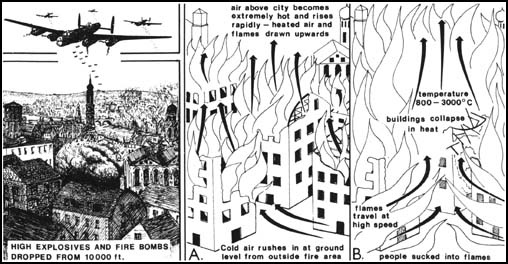
The bombing of Hamburg,3 began on 24th July, 1943 and lasted eight days and seven nights. It resulted in 40,000 dead and 900,000 displaced German families. ‘Firestorms’ slaughtered the civilian population. This was the intended consequence after extensive research.4 Harris wanted to burn Hamburg to the ground with its population.
Hamburg took months to re-establish pre-raid productivity. Nearly 200 major factories were destroyed in the bombing along with roughly 4,000 smaller ones. Hamburg would be bombed another 69 times before the end of the war, but it was the initial attacks on the city in 1943 that truly damaged much of Germany’s industrial strength.” (my emphasis)5
The merciless attack on civilians was successful but strategic success wasn’t achieved. Bombing Hamburg demonstrated that Germany couldn’t be defeated solely from the air. The scale of Allied attacks, which continued throughout the remainder of the war, is numbing, “By the end of the war, 305,000 Germans had died because of the bombings, with 1.8 million homes destroyed.”6 That this was a known strategic failure multiplies the horror.
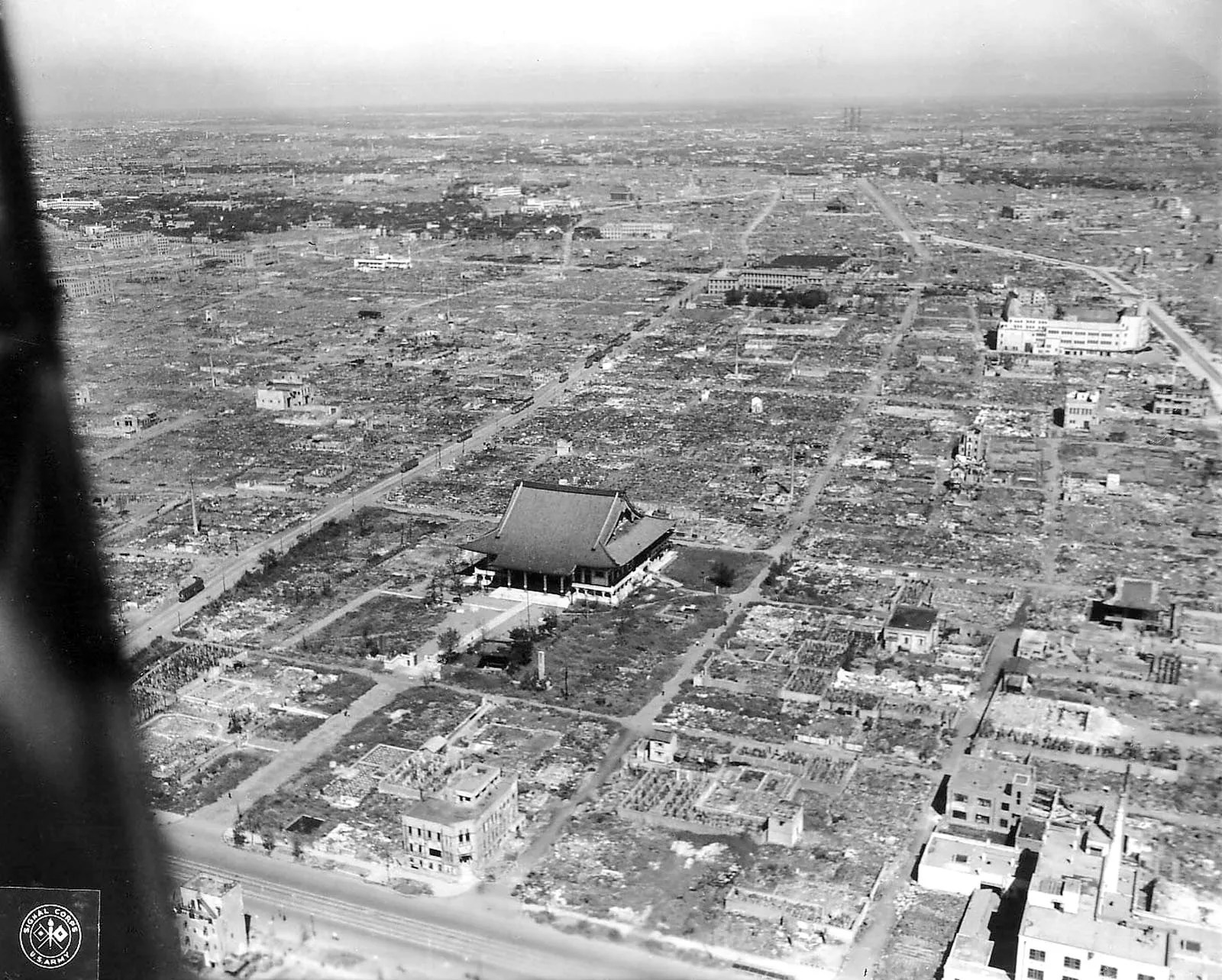
Japan’s experience was like Germany’s until the deployment of ‘A’ bombs. Their resistance also continued despite catastrophic damage and stupendous civilian casualties. The destruction of Hiroshima and Nagasaki is an iconic moment in the Second World War but fewer civilians were killed there than in Tokyo five months earlier.7 The incineration of civilians in Tokyo is a historical footnote, which is a comment on the novelty of the ‘A’ bomb attacks rather than their strategic importance.
The ‘A’ bombs succeeded where carpet bombing failed because they were technologically unknown terror weapons, which hadn’t been normalised by experience. “The night of the firebombing, the family had not sought cover in a shelter, made complacent by the almost-daily frequency of the raids.”8 (my emphasis) This wonderful personal account of the Tokyo bombing illustrates the futility of attempting to win wars from bombing campaigns.
The ‘A’ bombs turbocharged Japan’s surrender because the Americans had total control of the military situation. Japan was faced with the probability that every city would be razed to the ground. Emperor Hirohito’s capitulation speech didn’t acknowledge defeat. Instead, he said, “the war situation has developed not necessarily to Japan’s advantage”.9
The ferocious bombing campaigns of the Second World War didn’t win the war. Civilian morale didn’t collapse and the populations of the bombed nations didn’t rise up in anger against their governments. It’s opaque how far they contributed to ultimate victory. What isn’t opaque is that slaughtering civilians in the expectation of victory is the triumph of hope over experience.
Addendum: Bombing campaigns in 2023
The tit for tat use of drones against civilians in the Russo-Ukraine war is, on this analysis, futile and a distraction from the battlefield.
Likewise, Israel razing Gaza to the ground won’t work unless they copy the 1945 solution and have a military occupation for years.
The gun lobby always says, well, people need the right to protect their property. Every mass shooting is done by a guy who lives with his mother. I honestly believe you should have to have a mortgage to buy a gun. No one with a mortgage has ever gone on a killing spree. … A mortgage is a real background check … And you know if you go to jail for 30 years you still have to pay your f–ing mortgage.
Definition:An actuary is someone who is too boring to be an accountant.
To have a comedic thriller written with an actuary at its centre is amazing. And when that actuary is so boring he gets sacked because he doesn’t fit in with his colleagues…That’s off the scale amazing. That it works brilliantly is astonishing.
I bought the book because Amazon sent me a list with it priced at 52p. For 52p I’m a risk taker. What did I get?
An ultra boring actuary, who converts every human activity into maths, is ousted from his office. Simultaneously his brother, who owns an adventure park dies and leaves it to him. Being at a loose end he takes on the challenge.
Naturally he mathematically critiques every aspect of every activity without understanding the concept of joy. Being a thriller, we have bad guys – who are bested – and a quasi-Platonic love affair. He learns about art and human relationships.
Superb. It’s Finnish, which is a first for me, and the translation and names are accessible unlike Japanese novels.




 Odeboyz's Blog
A woman buys a parrot
“Polly is cheap because she lived in a brothel and has colourful vocabulary.”
“Don’t worry. She’s cheap and cheerful, I’ll take her.” Mary took Polly home and uncovered the cage
“New place – very nice,”
Just then Mary’s daughters walked in.
“New place, new girls – very nice,” Polly added.
When her husband walked in, Polly said cheerfully, “Hello, Keith!”