Lucy is a brilliant biographer. She uses her vivid writing skills to paint a picture of people and period. Her chapters range from a single page to full-scale analysis.
The book includes stunning colour plates of some the 17th century’s greatest art.
The duke of Buckingham (1592-1628) is amazing. He had superb ‘soft’ skills, which promoted his entry into King James’s inner-circle of courtiers. But he was unique as a courtier. James was homosexual. To be his ‘favourite’ you too had to be gay. Regardless of whether you were or not.
Every courtier wanted to be the king’s favourite but having a ‘love affair’ as a job! It didn’t matter whether Buckingham was sincere. For James all that mattered was that he believed it to be the real thing. Lucy’s suggests Buckingham was indeed the lover of James.
Buckingham was much more than the plaything of a queer king. And the book is brilliant in telling the story.
A long (628 pages) read but worthwhile.
Try this
“Buckingham’s own clothes for the trip were extravagantly beautiful. The suit in which he planned his entrance into Paris was of ‘rich white satin’ and white velvet, ‘set all over, both suit and cloak, with diamonds’. With it he would wear in his hat a ‘feather made with great diamonds’. His sword-belt, hatband and spurs would also be diamond-studded. The list-maker estimated the value of the outfit at £80,0001….enough to fund a four-month war.”
“Tesla has lost more than one-third of its market value since mid-December as Musk deepens his association with Trump.”1
Reputational damage is lethal. Gerald Ratner called his jewellery ‘crap’2 and within two years had lost his chain of companies. Tesla is identified with Musk personally. Tesla’s leadership in the mass electric vehicle (EV) revolution made Musk a multi-billionaire. EVs became, for a time, synonymous with Tesla.3
Keeping a sense of perspective as a multi-billionaire is challenging. Musk failed. He funded Trump’s 2024 election campaign with $277m and pivoted into politics. Multiple appearances at campaign events plus, Trump’s infatuation with extreme wealth, has given Musk unparalleled unelected power.
Musk believes he has unique managerial skills. He bought Twitter for $44bn by selling Tesla stock. He sacked 80% of the staff using his ‘infallible’ managerial ‘skills’.4 He rehired many of them days later because they held critical roles.5 Musk has reduced ‘X’’s (Twitter) valuation by 71%.6
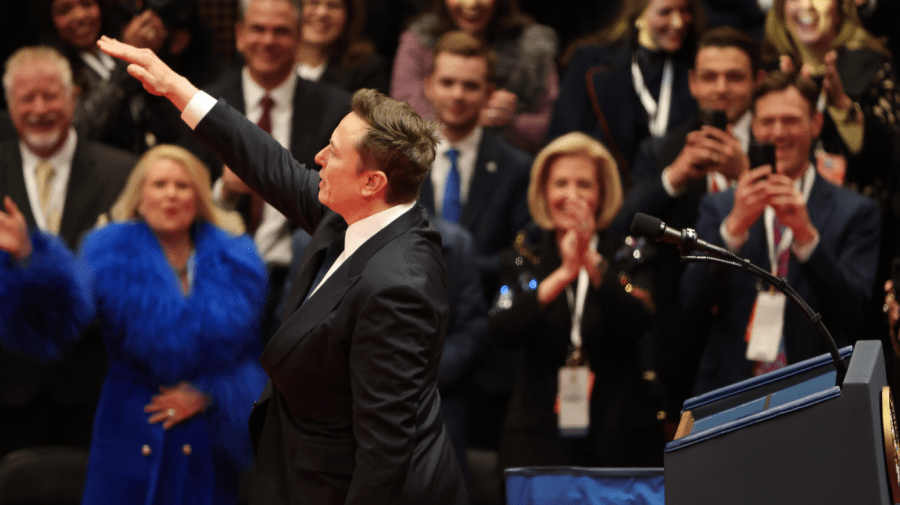
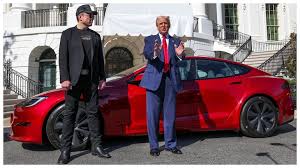
Ever since the infamous Nazi salute (see Addendum) Musk made at Trump’s inauguration, Tesla has become toxic. Its stock market valuation has plummeted.7 Trump made a lame effort to ‘rescue’ Tesla with a ‘choreographed‘ purchase at the White House. (see Addendum) Subsequently it seems Trump’s endorsement was, as it were, bought with a linked payment.8
Trump is dazzled by Musk’s wealth and assumes he’s a genius. He nurtured Tesla when it was struggling but can he replicate that success?
“…successful management is often not portable, because an ability to overcome constraints in one business doesn’t guarantee an ability to do so in others.”9
Evidence suggests Musk doesn’t have transferable management skills. Musk’s other companies were established with Tesla being used as a cash-cow. ‘X’, Space X, Starlink and the Boring Company are interesting but don’t have Tesla’s stellar qualities. His X-style mass sackings of Federal government employees is chaotic.
The Trump administration has halted the sackings of hundreds of US federal employees who worked on America’s nuclear weapons programmes.10
Trump worships wealth and therefore Musk. This has clouded his judgment. Worshipping wealth and losing a sense of reality isn’t new. Adam Smith identified the problem in 1759,
“Ambitious pursuers of wealth are driven by the desire to deserve and to enjoy recognition for their excellence, but their judgment of what is truly excellent is corrupted by the standards of a wealth-worshipping society.”11
Musk is worth about $370bn and Trump worships him because he’s 100 times richer than he is.
This YouTube video is extremely witty. Needless to relate I could join in with my memories of a 1940s childhood. But I won’t. I won’t because it would spoil your image of the ‘Good Old Days’.
In economics ‘Hedonic Treadmill’ explains that people believe who believe in recipes for happiness are doomed to failure. They’re on a ‘treadmill’ with entirely illusionary possibilities for happiness. Continuous pleasure-seeking feeds dissatisfaction. At its most extreme it is corrosive creating permanent dissatisfaction. This helps to explain addictive behaviour where hope turbocharges short bursts of bliss followed by despair.
I didn’t buy this book for insights into economics. I bought it because of its quirky title, which is shallow but true.
Dave Brookman, the protagonist, has a lovely suburban life. Loving wife, two children and a satisfying job in advertising. Everything is great until new neighbours arrive. His new neighbour is also called Dave Brookman with a wife, two children, works in advertising and the same age. A mirror image.
But
The new Dave Brookman has a bigger car, a larger garden and he owns his advertising company. The old Dave Brookman implodes with rage. He compares every aspect of his life deciding he’s a failure. The new Dave is 46% better than he is. This is the plot.
Utterly mad, preposterous, implausible and compelling.
“My first trouble came when I got mixed with a bad crowd. One night we wanted to do something exciting.”
“We stuck up a restaurant and I wound up in jail. I didn’t mind prison. I figured I had to pay for what I did. It was the first time in my life I got three square meals a day.”






 Odeboyz's Blog