
Russia’s annexation of Crimea was textbook perfect. Putin gained the tacit approval of the international community. This was essential for an unqualified success. A consequence was that the Ukraine itself was undermined. Putin’s justification for the annexation, the correction of an anomaly, was broadly accepted. The anomaly happened when Khruschev ‘gave’ Crimea to the Ukrainians in 1954.1 Khruschev’s decision was a gamble as 75% of Crimea’s population was Russian and it was home to the Soviet Black Sea fleet.
“…Khrushchev saw the transfer as a way of fortifying and perpetuating Soviet control over Ukraine now that the [post-1945] civil war had finally been won. Some 860,000 ethnic Russians would be joining the already large Russian minority in Ukraine.”2
Khruschev wanted Ukraine to become more Russian by diluting ethnic Ukrainian domination.
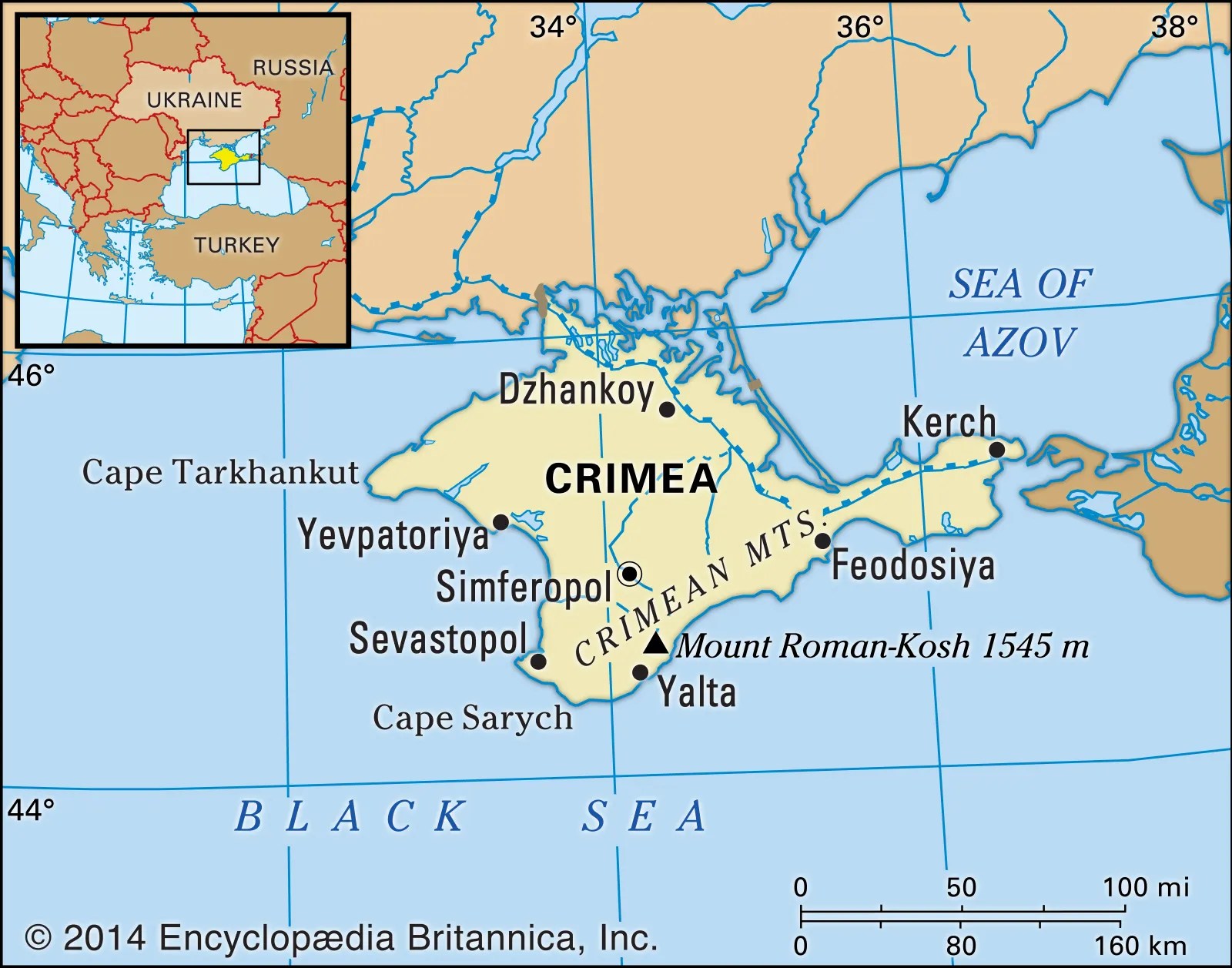
The Sevastopol naval base was built in Crimea in 1772 as a harbour for Russia’s Black Sea fleet.3 After 1954 it continued as a Soviet naval base. This was modified in the post-Soviet period.
In February 1945, the Crimean city of Yalta hosted the Big Three Conference.4 That Stalin chose Yalta for a pivotal moment in European history shows Crimea’s importance to the Soviets. Putin believed the 1954 transfer was quixotic and wasn’t intended to recognise Ukraine as a nation-state. The international response to the annexation – epitomised by Britain’s cosmetic condemnation – agreed with this analysis. (see Addendum)
Russia’s annexation was predicated on the ethnicity of Crimea’s population. The primacy of the ethnic principle for nationality was established with disastrous consequences. Ethnicity as a decisive factor in the geopolitics of Ukraine turbocharged mission creep for Putin.
The Donbas eastern flank of Ukraine was,
By the time of the Soviet Census of 1989, 45% of the population of the Donbas reported their ethnicity as Russian.5
Industrial decline in the Donbas coupled with political unrest was capitalised on by Putin after 2014. The next few years saw military action with Kiev control of swathes of eastern Ukraine passing to the separatists. Ukraine stood alone despite the unmistakable direction of travel. For Putin the ‘historic anomaly’ was Ukraine and not just Crimea.
The international community’s acceptance of the 2014 annexation of Crimea is the father of the Russia-Ukraine war.
Addendum: The UK’s response to the annexation
“United Kingdom – The Foreign Secretary William Hague said he was “deeply concerned” at the escalation of tensions and the decision of the Russian parliament to authorise military action. He also said “This action is a potentially grave threat to the sovereignty, independence and territorial integrity of Ukraine. We condemn any act of aggression against Ukraine”.[110]
On 2 March 2014, British Prime Minister David Cameron announced that government officials were planning to boycott the 2014 Winter Paralympics in Sochi in response to the situation in Crimea, while Prince Edward cancelled plans to travel to Sochi for the Games “on the advice of government.” These decisions will not affect Great Britain’s participation in the Games.[111] Cameron also said “No amount of sham and perverse democratic process or skewed historical references can make up for the fact that this is an incursion into a sovereign state and a land grab of part of its territory with no respect for the law of that country or for international law.” (my emphasis)
Source International reactions to the annexation of Crimea by the Russian Federation – Wikipedia
Notes
1 Why Did Russia Give Away Crimea Sixty Years Ago? | Wilson Center
2 loc.cit.
3 Sevastopol Naval Base – Wikipedia
4 Churchill, Roosevelt and Stalin


 Odeboyz's Blog