
The Apostles’ Creed
I believe in the Holy Spirit, the holy catholic Church, the communion of saints, the forgiveness of sins, the resurrection of the body, and the life everlasting. Amen1
The Church guides believers to Heaven.2 This satisfied everyone until Cranmer’s Reformation3 destroyed religious certainties. He ended the rule of the Roman Catholic Church in England by introducing a new format for worship. Those who resisted Cranmer’s reforms paid with their lives. In 1553, Queen Mary, a devout Catholic, committed herself to undoing his reforms. Cranmer had made it possible for Henry VIII to divorce her mother. The consequence for Mary was that she lost her position as a princess and, even worse, was in mortal peril for 20 years.
Cranmer was the principal force behind the English Reformation: When Mary was crowned queen after the death of her brother, she seized her opportunity. Cranmer had to pay the ultimate price for destroying the Roman Catholic Church in England. Her theology was fuelled by hatred of Cranmer. Her mother’s divorce meant she lost her coveted status as a princess because she was now ‘illegitimate’. After this she lived as a prisoner at the mercy of Henry VIII. Cranmer’s execution was a certainty. But ‘hope springs eternal’ and he prostrated himself and repudiated his reforms. For anyone else this would have saved his life but he was Cranmer. Mary was implacable. He could do, and say, absolutely nothing to rescue himself. He was doomed.
Cranmer faced a dreadful dilemma on the 20th March 1556. On the following day he had to attend the University Church, Oxford to deliver a further recantation of his Protestant faith. He’d already done so five times previously and it hadn’t been accepted. He finally appreciated there was nothing he could do that would save him from Mary’s wrath. He was going to go to the stake on the 21st March and so his final reckoning with God was 24 hours away. His calculation was that the savage death he would suffer was nothing in comparison to angering God. Cranmer decided that the excruciating agony of being burned at the stake was a lesser punishment than eternal damnation. He shocked those who were in the church by rebutting his denials of adherence to the Protestant faith. He went further and condemned the Papacy,
And as for the Pope, I refuse him as Christ’s enemy, and antichrist, with all his false doctrine.4
Cranmer had previously betrayed his principles and nothing could conceal the self-serving nature of his recantation. Mary was correct,
[She] was unwilling to believe that the submission was sincere, and he was ordered to be burned at Oxford on 21 March 1556. At the very end, he repudiated his final letter of submission, and announced that he died a Protestant. He said, “I have sinned, in that I signed with my hand what I did not believe with my heart. When the flames are lit, this hand shall be the first to burn.” And when the fire was lit around his feet, he leaned forward and held his right hand in the fire until it was charred to a stump.5
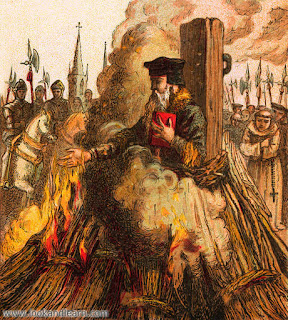
Cranmer’s execution is lauded by Protestants but it had many squalid features. Only his ringing statement on 21st March 1556 is praiseworthy. The back story to that statement shows a man full of doubts, fear and cowardice. He was a political archbishop and his death became part of the political narrative of Protestantism.
Notes
1 The Apostles’ Creed, 1549, is said in Church of England services as a statement of the ultimate principles of faith. Cranmer wrote this in English in the transition from the Latin Roman Catholic services. This is a key part of the Reformation.
2 Calvinists don’t believe this. They believe in ‘predestination’ where God’s ‘chosen ones’ will enter Heaven regardless of their behaviour. What Is Calvinism? A Simple Explanation of Its Terms, History & Tenets
3 For a quick summary see Reformation – Wikipedia
4 The Unlawful Execution of Thomas Cranmer – 21 March 1556 – The Anne Boleyn Files This quote is from his speech at the church
5 Hugh Latimer & Nicholas Ridley Cranmer had to watch as his fellow bishops Latimer and Ridley were burned at the stake in October 1555


 Odeboyz's Blog