
Conventional war is more-or-less equal armies slugging it out. The paradigm is the First World War. This ended when Germany was outnumbered with the entry of the USA. The European Second World War ended with Germany outnumbered once more. Japan drew their conventional war in 1945 but lost to technological innovations. The world’s final conventional war, Korea 1950-53, was drawn. The current Russia-Ukraine war is a hybrid with technology beginning to dominate. It will probably end in a draw, unless Russia is bled dry by Ukraine’s allies.
Leadership
“You are not able to go out against this Philistine and fight him; you are only a young man, and he has been a warrior from his youth.” 1 Samuel 17:33 The David and Goliath Biblical story.
Saul’s decision allowing David to fight Goliath was existential. If David lost, Saul’s army became slaves. David’s intervention was transformative. Goliath was supreme in hand-to-hand battle but couldn’t reach David who fought from a distance. Saul was a great leader because he recognised that a conventional battle would end in defeat and therefore he used unconventional methods.
Innovation
The Vietnam wars began in the 1940s against the French, who they defeated, and later, against America. One innovation of Vietnamese generals was underground warfare in the Cu Chi1 tunnels. Very narrow, extensive and booby-trapped, they were extremely difficult to counter-attack. Guerrilla attacks continuously surprised and demoralised the Americans.
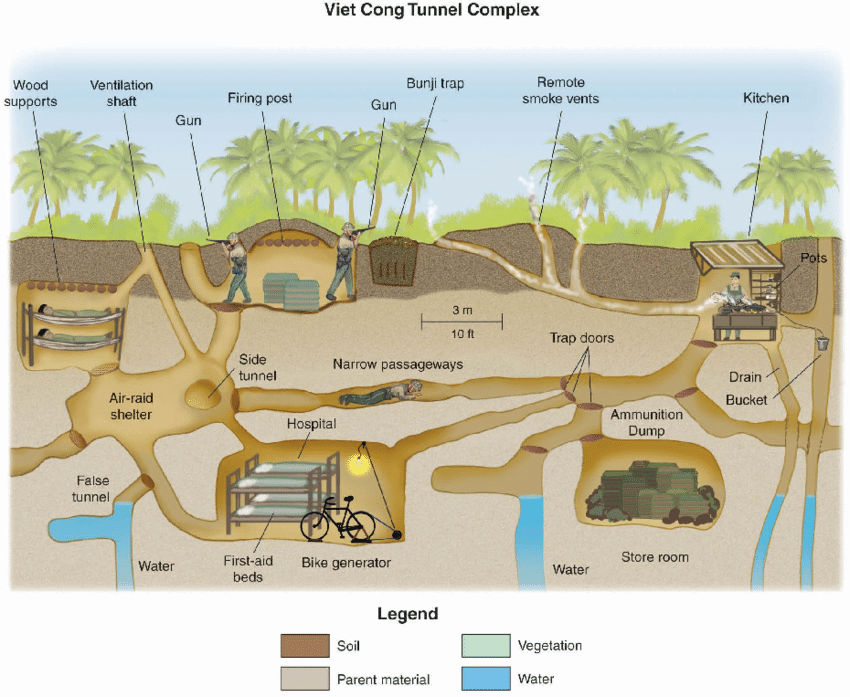
Their other principal innovation was supply routes through Laotian jungles.2 The Americans attacked those routes with saturation bombing. These attacks were war crimes, costing international support because Laos was neutral.
Technological Advances
By 1945, the Japanese were defeated. America controlled the skies and Japan’s armies were stretched across Asia and the Pacific islands. The battle of Iwo Jima,3 17th February-26th March 1945, persuaded president Truman the human cost of invading Japan was too high. He authorised atomic weapons. ‘A’ bombs indiscriminately slaughtered tens of thousands of civilians and so this was a war crime. The obliteration of Hiroshima and Nagasaki, August 1945, ended the war. The Japanese didn’t lose a conventional war, which makes this the first draw of the new era.
Partisan warfare
Germany conquered the European part of the Soviet Union in 1941 but it remained unsubdued. The Soviets undertook two forms of asymmetric warfare.4 Firstly, they used scorched earth where anything usable was destroyed. Secondly, partisans battled ferociously behind Germany’s frontline. Other conquered countries did likewise but less successfully.5
Philosophy6
Clausewitz said,
‘Military genius’ is not simply a matter of intellect, but a combination of qualities of intellect, experience, personality, and temperament (and there are many possible such combinations) that create a very highly developed mental aptitude for the waging of war.6
Philosophy places war within a holistic context considering the principal objectives of why diplomacy has failed. Famously Clausewitz said, “…we claim that war is nothing more than a continuation of the political process by applying other means.” This is precisely what didn’t happen prior to the First World War. Politicians discussed the reason for the war after it ended. Woodrow Wilson’s so-called 14 Points appearing from nowhere gave shape to the peace treaties.7 Likewise Israel. Generals dictate policy and have given Israel a siege mentality as they are surrounded by walls. Israeli generals shape political policy believing Israel will be permanently besieged. This negates Clausewitz’s insight.
Conclusion
Games of chess should end in draws as both players know the moves and everything is in clear view. Technological wars are like chess games rendering events, like the Charge of the Light Brigade, redundant. The primacy of technology has been evident for some time but the use of drones in the Russia-Ukraine war is instructive. Wars aren’t won on battlefields. Technology wins wars and innovation is everything. Battlefields are a quaint historical memory, like medieval sieges.
Notes
2 Laos during the Vietnam War (alphahistory.com)
3 Battle of Iwo Jima – Wikipedia
4 1) Scorched earth – Wikipedia 2) Soviet partisans – Wikipedia
5 French Resistance – Wikipedia
6 Carl von Clausewitz – Wikipedia He recognised the mobilisation of civilian populations into guerrilla units for example.
7 Fourteen Points – Wikipedia This was much to the surprise of the principal European leaders but they managed to water Wilson’s theories down – especially in regard to their imperial possessions.


 Odeboyz's Blog