“My current favourite is Rozsavolgyl Csokolade – Sur Del Largo, £9:95/70gr, Venezuelan beans, made in Hungary; this bar is ‘beautifully balanced’ – the notes say so and I agree. Very classy, so tasty and elegantly wrapped.”
Annalisa Barbieri Observer Magazine 5th January 2024
I believe in the Holy Spirit, the holy catholic Church, the communion of saints, the forgiveness of sins, the resurrection of the body, and the life everlasting. Amen1
The Church guides believers to Heaven.2 This satisfied everyone until Cranmer’s Reformation3 destroyed religious certainties. He ended the rule of the Roman Catholic Church in England by introducing a new format for worship. Those who resisted Cranmer’s reforms paid with their lives. In 1553, Queen Mary, a devout Catholic, committed herself to undoing his reforms. Cranmer had made it possible for Henry VIII to divorce her mother. The consequence for Mary was that she lost her position as a princess and, even worse, was in mortal peril for 20 years.
Cranmer was the principal force behind the English Reformation: When Mary was crowned queen after the death of her brother, she seized her opportunity. Cranmer had to pay the ultimate price for destroying the Roman Catholic Church in England. Her theology was fuelled by hatred of Cranmer. Her mother’s divorce meant she lost her coveted status as a princess because she was now ‘illegitimate’. After this she lived as a prisoner at the mercy of Henry VIII. Cranmer’s execution was a certainty. But ‘hope springs eternal’ and he prostrated himself and repudiated his reforms. For anyone else this would have saved his life but he was Cranmer. Mary was implacable. He could do, and say, absolutely nothing to rescue himself. He was doomed.
Cranmer faced a dreadful dilemma on the 20th March 1556. On the following day he had to attend the University Church, Oxford to deliver a further recantation of his Protestant faith. He’d already done so five times previously and it hadn’t been accepted. He finally appreciated there was nothing he could do that would save him from Mary’s wrath. He was going to go to the stake on the 21st March and so his final reckoning with God was 24 hours away. His calculation was that the savage death he would suffer was nothing in comparison to angering God. Cranmer decided that the excruciating agony of being burned at the stake was a lesser punishment than eternal damnation. He shocked those who were in the church by rebutting his denials of adherence to the Protestant faith. He went further and condemned the Papacy,
And as for the Pope, I refuse him as Christ’s enemy, and antichrist, with all his false doctrine.4
Cranmer had previously betrayed his principles and nothing could conceal the self-serving nature of his recantation. Mary was correct,
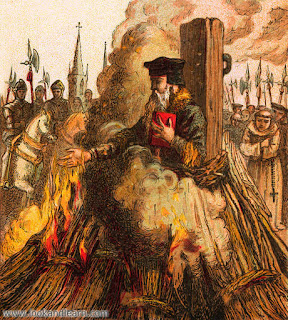
[She] was unwilling to believe that the submission was sincere, and he was ordered to be burned at Oxford on 21 March 1556. At the very end, he repudiated his final letter of submission, and announced that he died a Protestant. He said, “I have sinned, in that I signed with my hand what I did not believe with my heart. When the flames are lit, this hand shall be the first to burn.” And when the fire was lit around his feet, he leaned forward and held his right hand in the fire until it was charred to a stump.5
Cranmer’s execution is lauded by Protestants but it had many squalid features. Only his ringing statement on 21st March 1556 is praiseworthy. The back story to that statement shows a man full of doubts, fear and cowardice. He was a political archbishop and his death became part of the political narrative of Protestantism.
Notes
1 The Apostles’ Creed, 1549, is said in Church of England services as a statement of the ultimate principles of faith. Cranmer wrote this in English in the transition from the Latin Roman Catholic services. This is a key part of the Reformation.
The time for forgiveness has gone Gales howl across mountain peaks Trees are bundled to the ground Animals crushed and left to die No-one cares
The time for forgiveness has gone Fires rage devouring houses Sparks a thousand feet high And drones admire the sight A wonderful spectacle
The time for forgiveness has gone War a snuff movie for bored couch warriors, but Keeping the excitement high Is so hard Where there’s a will there’s way
If my theory of relativity is proven successful, Germany will claim me as a German and France will declare me a citizen of the world. Should my theory prove untrue, France will say that I am a German, and Germany will declare that I am a Jew.
Mesut Ozil (footballer)
“When we win, I am German. When we lose, I am an immigrant.”
The British Empire was founded on the Royal Navy and Nelson’s triumph at Trafalgar sealed British naval supremacy. The importance of Trafalgar was that it brought naval and global domination for 136 years.
Naval supremacy transformed Britain into ‘The policeman of the world’. An early example was the abolition of the slave trade,
“The Royal Navy, which then controlled the world’s seas, established the West Africa Squadron in 1808 to patrol the coast of West Africa, and between 1808 and 1860 they seized approximately 1,600 slave ships and freed 150,000 Africans who were aboard.”1
In 1871 Britain transitioned to steam powered ships and established coaling stations around the world.2 This enhanced British supremacy. Other nations didn’t have the security of coal supplies and their ships couldn’t compete across the world’s oceans. They had to concede British supremacy.
The 18893 two-fleet law demanded that the Royal Navy was equal to the next two largest fleets combined. This lasted until the 1930s. During the first world war Germany’s fleet was defeated at the battle of Jutland, 1916, ending Germany’s naval challenge. The Royal Navy’s blockade of Germany cut off food and industrial supplies causing widespread hunger and problems in their factories. This weakened their ability to resist the Allied armies.
The beginning of the end of British supremacy was the Japanese destruction of Russia’s Pacific and Baltic fleets in 1905 at the battle of Tsushima.4 For the first time Britain had to recognise that their ability to control every ocean had ended. Tsushima was the precursor of Britain’s declining power. It was a pivotal moment in global history.
Spain are the European champions. Real Madrid won the Champions League. Rodri won the Ballon d’Or and has only come to seem more important since suffering an anterior cruciate injury. Spanish managers won the Premier League, the Bundesliga and League 1 last season. No fewer than five1 Premier League clubs are managed by Spaniards.
The Observer (Sport section)29th December 2024 p20
Note
1 There are three British born managers in the Premier League as of 30th December 2024




 Odeboyz's Blog